01
Submit once
The person provides the issue and relevant evidence once—and receives one durable case number.
A public-interest governance standard
A normal support experience is continuous, accurate, accountable, and human. It protects the person’s time, identity, evidence, and trust from first report through lasting resolution.
One issue. One case number.
End-to-end. No runaround.
Right team. Right expertise.
Real resolution. Not a temporary fix.
The service journey
Every step produces an observable outcome. The person always knows what happened, who owns the case, and what comes next.
The person provides the issue and relevant evidence once—and receives one durable case number.
The correct team confirms receipt, names the issue, and gives a realistic update window.
Support reads the record, restates the issue accurately, and asks before making assumptions.
Information is collected proportionately, with a reason for each sensitive request.
The case reaches the right expertise without making the person repeat their history.
A named owner or accountable team remains visible through every internal handoff.
Updates explain what was checked, what is known, and what happens next.
The issue is fixed, or a concrete escalation path and decision point are documented.
Support verifies the outcome with the person; silence is not treated as consent.
If the problem returns, the same record reopens without erasing history or starting over.
Operational safeguards
Good intentions are not a control. These safeguards turn respectful service into a repeatable, auditable system.
One issue. One record. No fragmented case trail.
The record reflects what the person actually reported.
Sensitive identity evidence is requested only when necessary.
Every handoff, access, request, and decision is documented.
A responsible owner remains answerable for the outcome.
The correction reaches connected systems—not only the visible screen.
This is not normal support
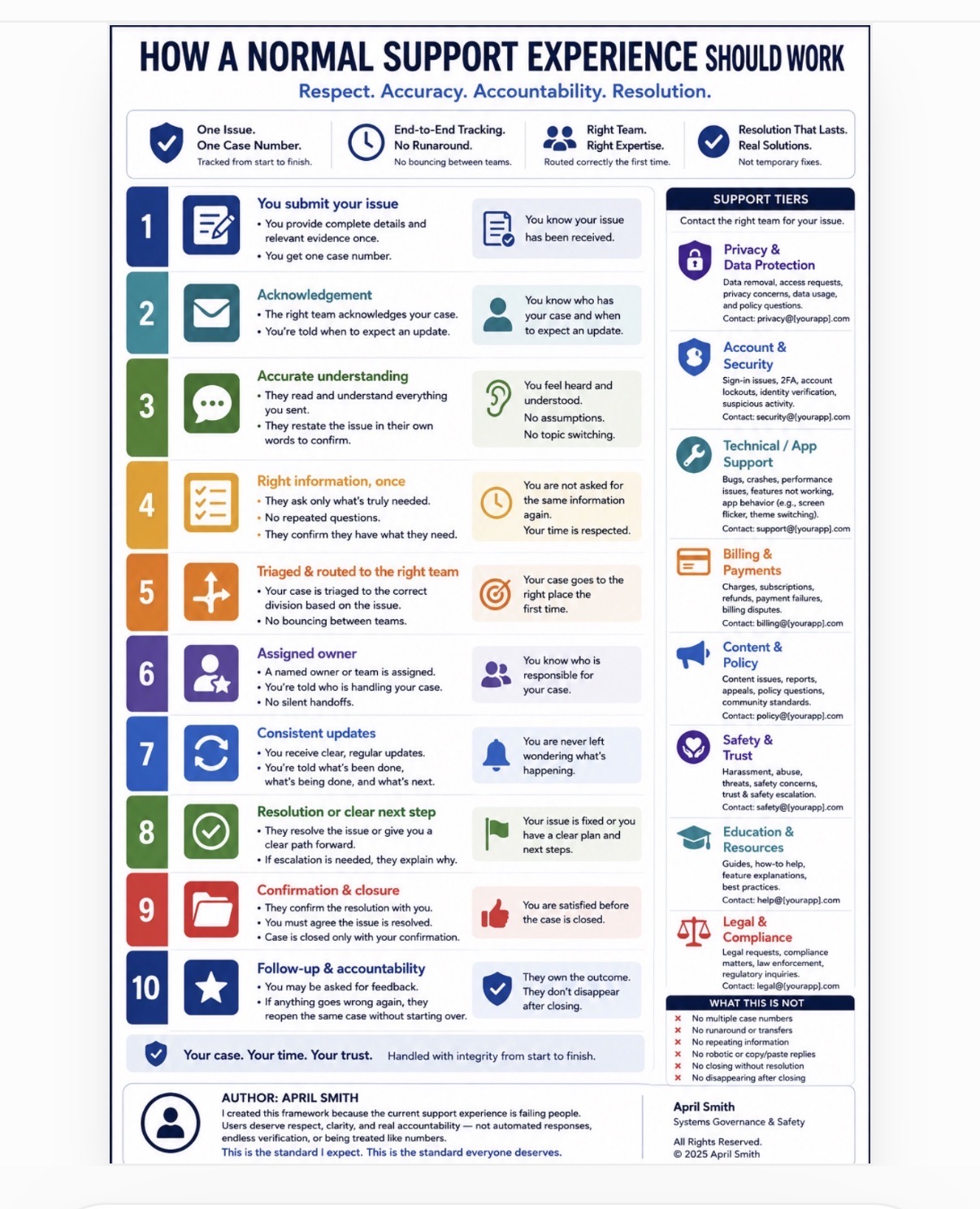
Original visual framework
This visual establishes the practical model: ten sequential duties, correct routing, clear ownership, and closure only after confirmation.
A standard worth adopting
Organizations should be able to demonstrate continuity, explain decisions, protect identity evidence, correct connected records, and remain accountable until the person confirms a durable outcome.
Return to the standard